Overview
Six days from Marrakech for women travelling without male companions — solo female travellers, mother-daughter trips, female friend groups, women's groups. Two nights in Marrakech with a female cultural guide, henna application by a women's collective, hammam evening at a female-managed riad. Then south through the Atlas to Aït Benhaddou with a stop at a women's argan cooperative, the Sahara at Erg Chebbi, and the Gnawa village of Khamlia with the Berber women who tell its stories. The trip ends with a cooking class at the Amal Center, a real Marrakech NGO that has trained over 300 disadvantaged Moroccan women in culinary skills since 2012. Female driver-guide for the entire 6 days. Fully private.
Day by Day
Welcome to Morocco. We meet you at Marrakech-Menara airport (RAK) whenever your flight lands. Your female driver-guide will be holding a sign with your name in arrivals.
The drive from RAK to your riad in the Marrakech medina is short — fifteen to twenty minutes depending on traffic. We hand you over to your riad host (also a woman) at the door of the medina; the alleys to your riad are too narrow for vehicles, so a porter will help with your luggage on the short walk in.
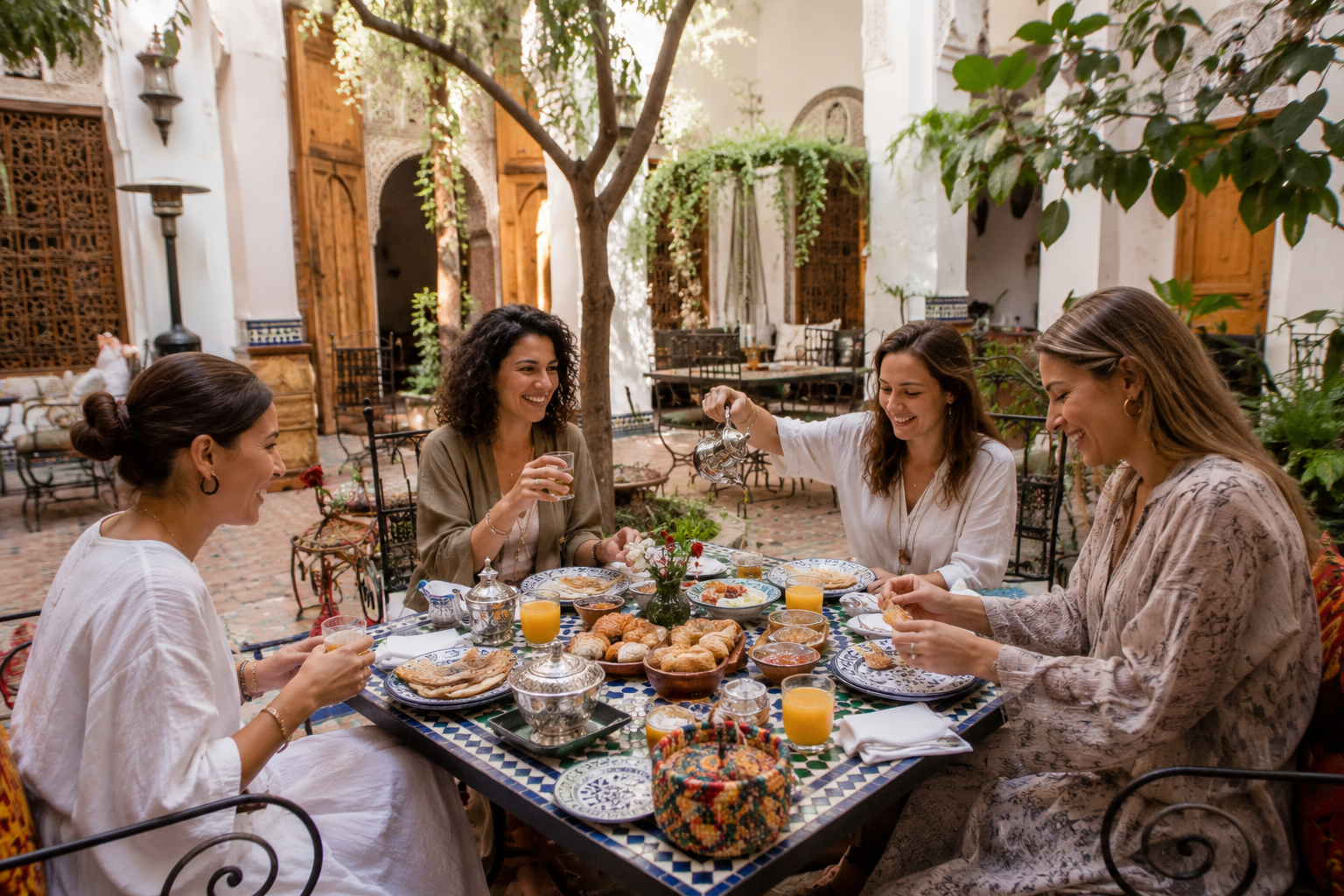
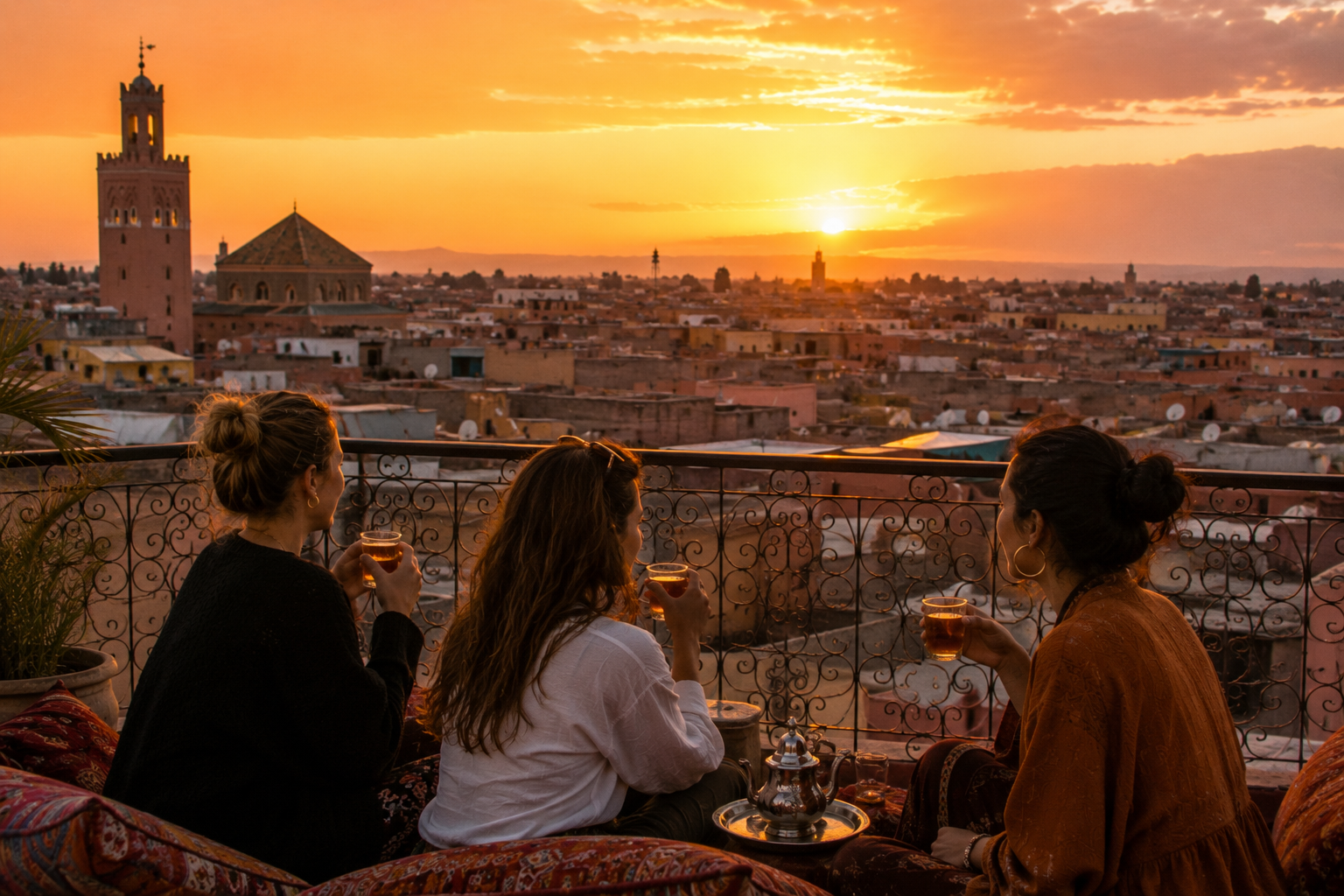
Your riad is a traditional Marrakech house built around a central courtyard, owned and managed by a Moroccan woman. The rooms are en-suite, the courtyard has a small plunge pool and a fountain, and the rooftop has a view of the Atlas Mountains on a clear day.
The afternoon is yours to settle in — a tea on the rooftop, a nap, a short walk in the alleys around the riad. We do not schedule activity for Day 1; jet lag is real and we'd rather you start the trip rested.
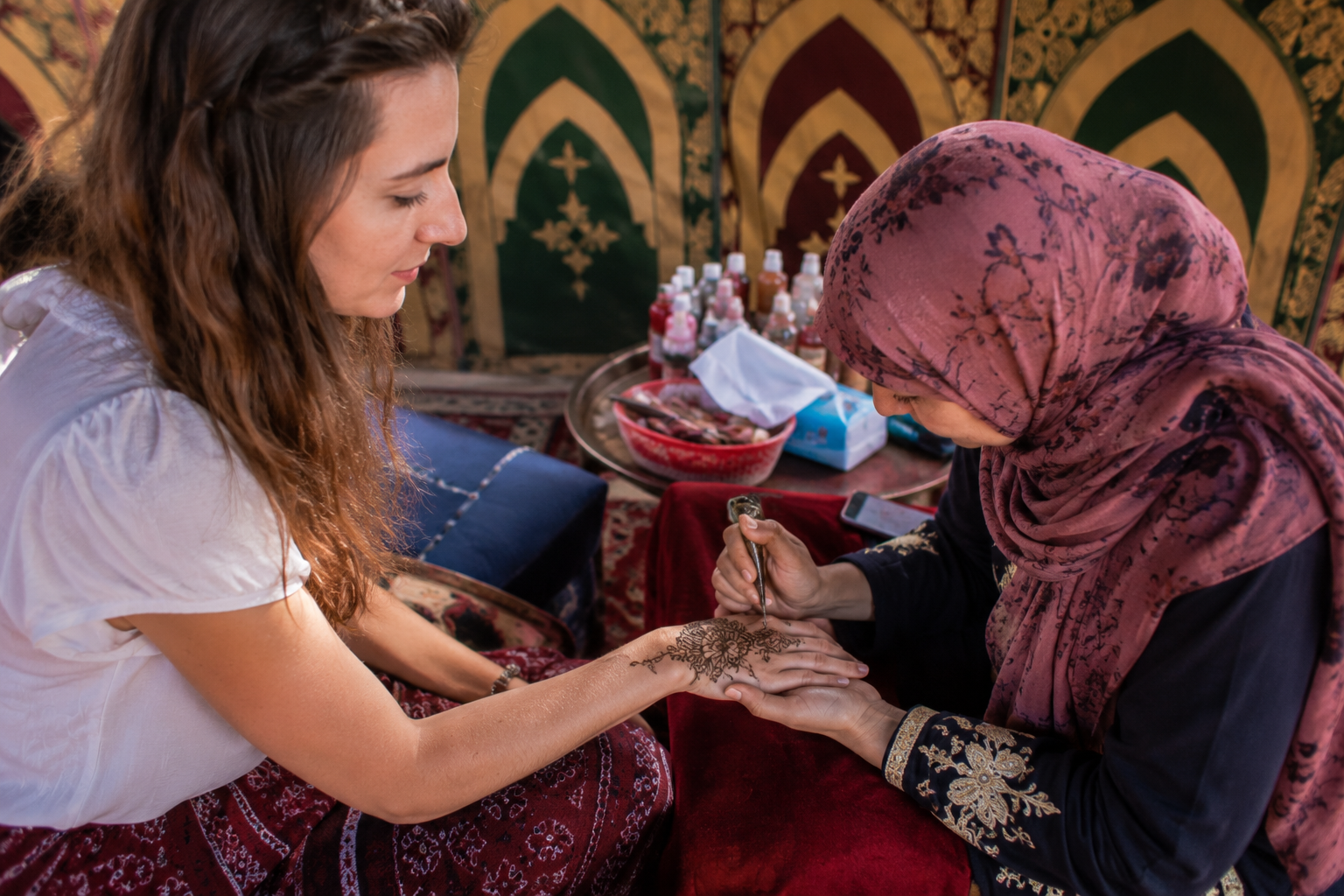
In the evening, the Henna Cafe woman comes to the riad for the henna application — about thirty minutes for a hand or wrist design, longer for elaborate work, paid by us. The Henna Cafe is a women-led NGO offering henna, cooking workshops, and supporting women's literacy programs in Marrakech; the artist will tell you about the work as she paints. Henna lasts seven to ten days and darkens overnight; the colour you have at dinner is paler than the colour you have on Day 2.
Dinner is at the riad, prepared by the riad's female cook — a multi-course Moroccan meal with starters, a tagine or pastilla, and dessert. Our team owner sometimes joins for tea after dinner if she's in town.
You spend the night in your Marrakech riad with an en-suite room. Dinner is included. There is no long driving on Day 1.
Note: if your flight arrives after 8:00 PM, we shift the henna to Day 2 evening. Tell us your flight number when booking.
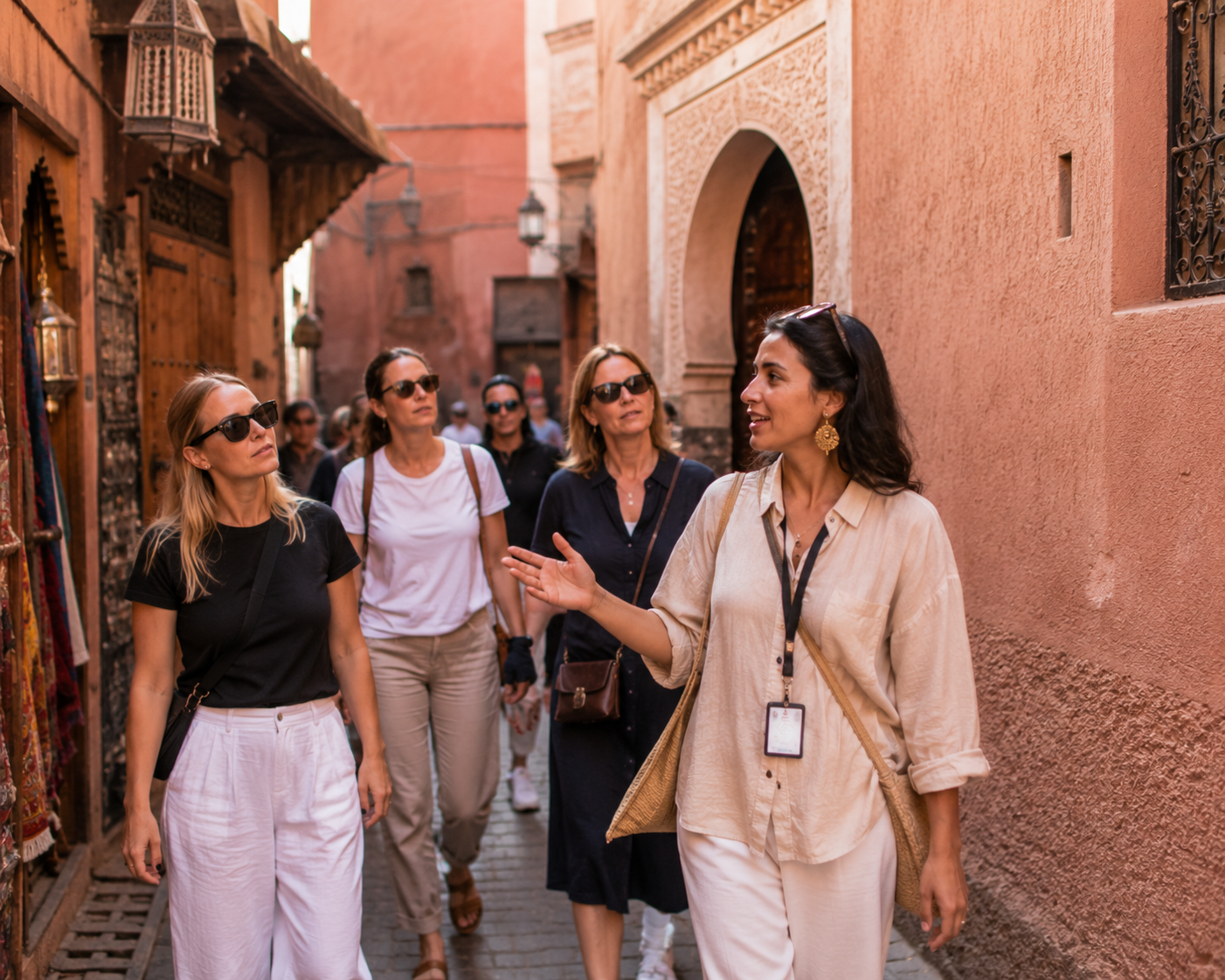
Today is on foot, with a licensed female cultural guide. She is Marrakchia — born in this city, trained as a guide in the 2010s when Marrakech began licensing female guides. She works almost exclusively with women's tours.
The morning starts with the Bahia Palace — late nineteenth century, built for the grand vizier Si Moussa, with carved cedar ceilings, zellij tile, and the largest harem courtyard in Morocco (entry 70 MAD). Your guide explains how the building was used and what daily life looked like for the women who lived there. From the palace we walk through to Le Jardin Secret — a restored sixteenth-century riad and Islamic garden in the heart of the medina, with two distinct gardens (an Islamic garden and an exotic garden) and one of the few quiet spaces inside the medina (entry 60 MAD).
By midday we walk to the Henna Cafe in the Marrakech medina (Derb Sqaya, near the Mouassine Mosque). Lunch is served in the small courtyard — a chicken or vegetable tagine with bread and salads. The cafe is run by Moroccan women and the proceeds support women's literacy programs. Lunch is included; about 100 MAD per person value.
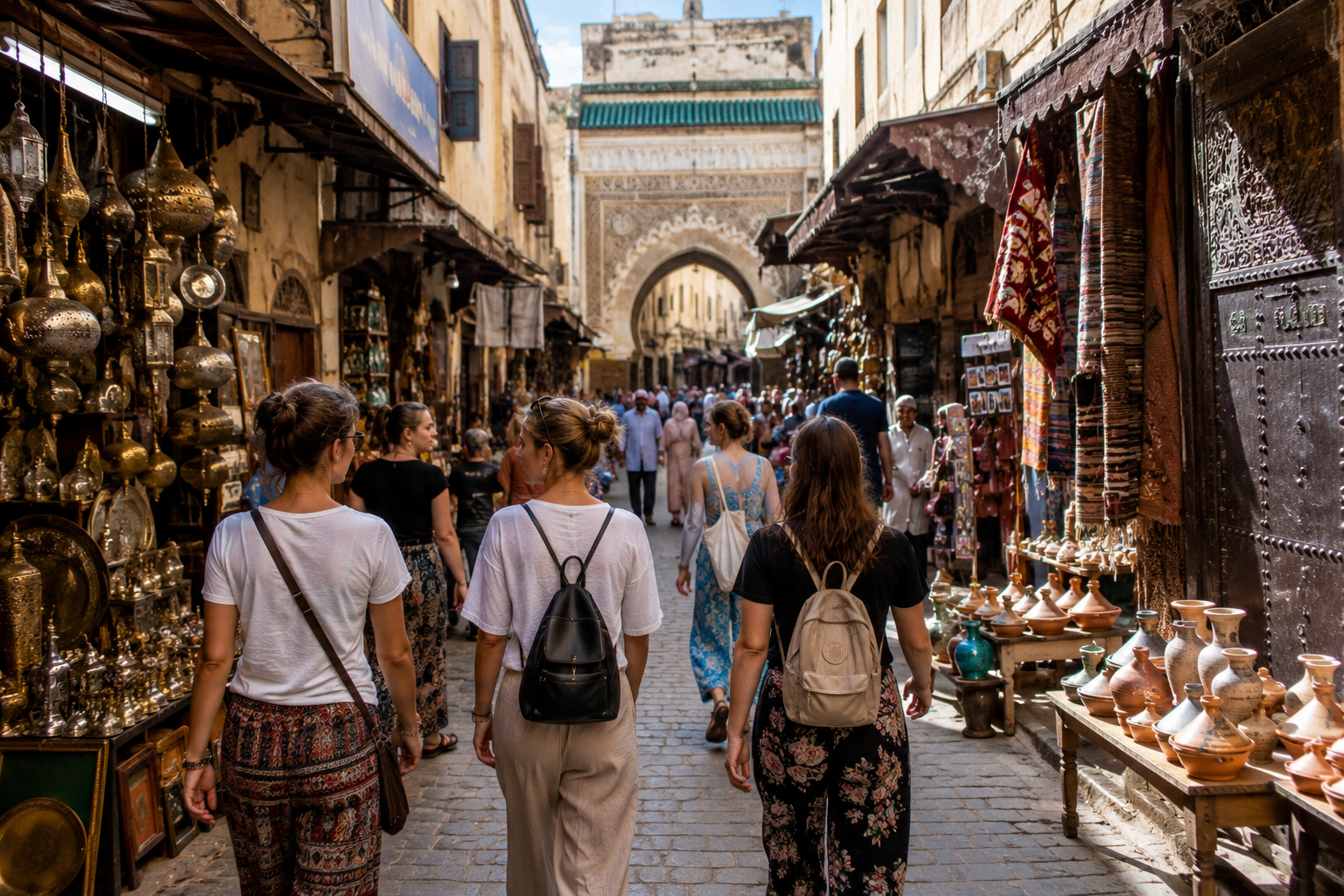
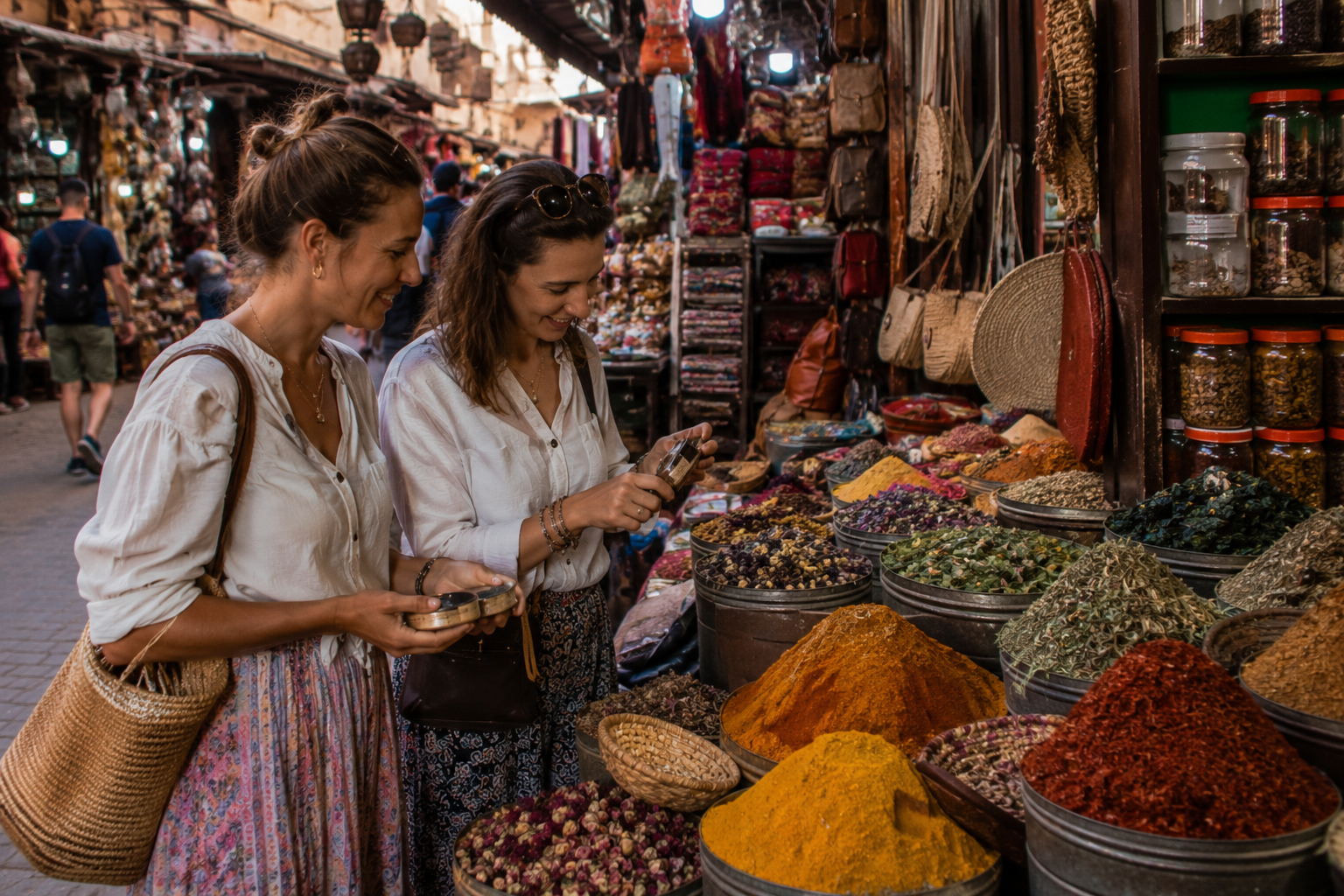
After lunch, the souks. Your guide walks you through the women-led workshops first: the embroiderers, the kaftan-makers, the spice traders. She points out which sellers are female-owned (more than you'd expect — Marrakech's textile and cosmetics trades are largely women-run, especially since the 2000s). We avoid the leather souk (the smell, and most leather workshops are male-staffed). The pace is yours; we plan for two to three hours of medina walking with rest stops.
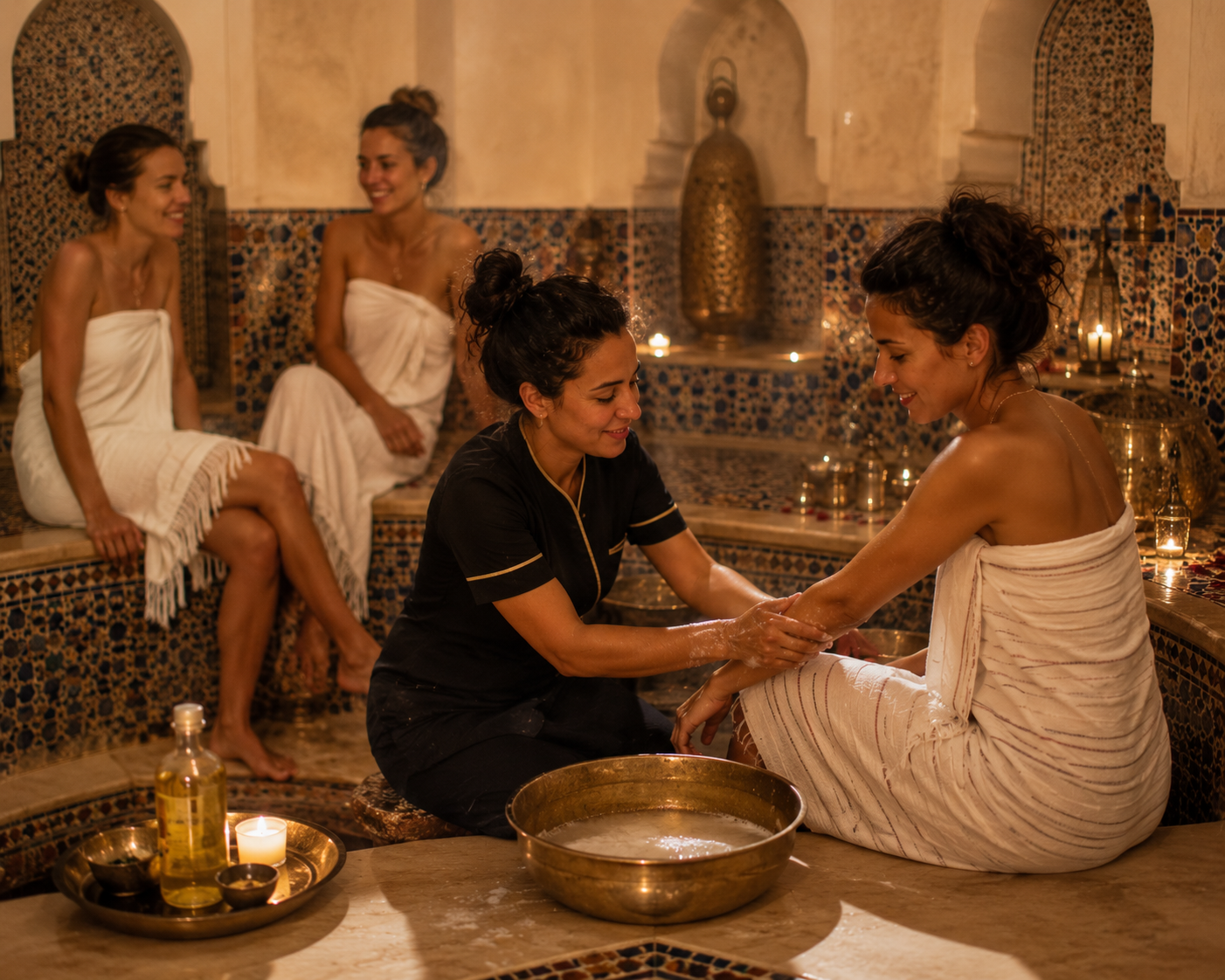
By 4:00 PM you are back at the riad. We have booked a women-only hammam slot at the riad for the evening — the riad's small hammam is reserved for our group from 6:00 PM to 8:00 PM. The hammam is two hours of soak, scrub (with a female attendant), rinse, rest. Bring a swimsuit if you prefer; bare or undressed is also normal. About $40 per person, paid to the riad.
Dinner is at the riad rooftop, late, after the hammam.
You spend a second night in your Marrakech riad. Breakfast and dinner are at the riad and lunch is at the Henna Cafe — all included. The hammam is at your own expense ($40 per person if you choose; not compulsory).
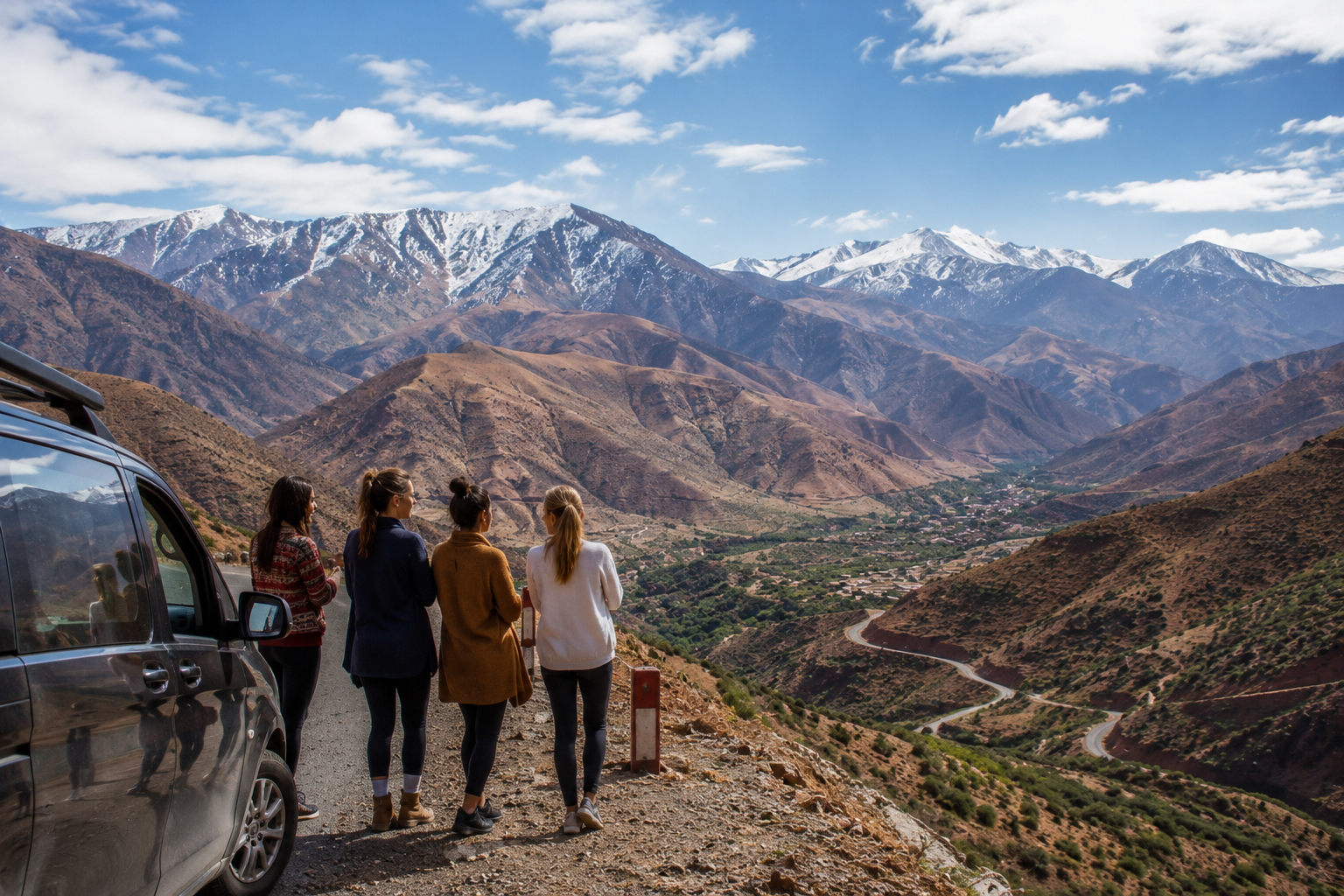
We collect you at 8:30 AM. The morning is the High Atlas: we drive south out of Marrakech and climb the Tizi n'Tichka pass at 2,260 metres — the highest road crossing in North Africa. Stops along the way for photos and tea at Berber roadside stalls (often run by women selling argan oil, almonds, and bread).
The first major stop is the women's argan oil cooperative just below the Atlas, near the village of Talouine on the road to Ouarzazate. The cooperative is a working operation — about twelve to fifteen women crack the argan nuts by hand (an ancient technique only women do — the right grip and rhythm comes from years of practice), grind the kernels with a stone mill, and produce oil for cosmetics and culinary use. Most "argan" oil sold in Marrakech souks is cut with sunflower oil; the oil from this cooperative is genuine, traceable, and the proceeds go directly to the women working there. We allow about thirty minutes; you can buy a small bottle if you'd like (a 250ml bottle of culinary argan oil is around 200 MAD; cosmetic argan oil similar). No pressure — looking is fine.
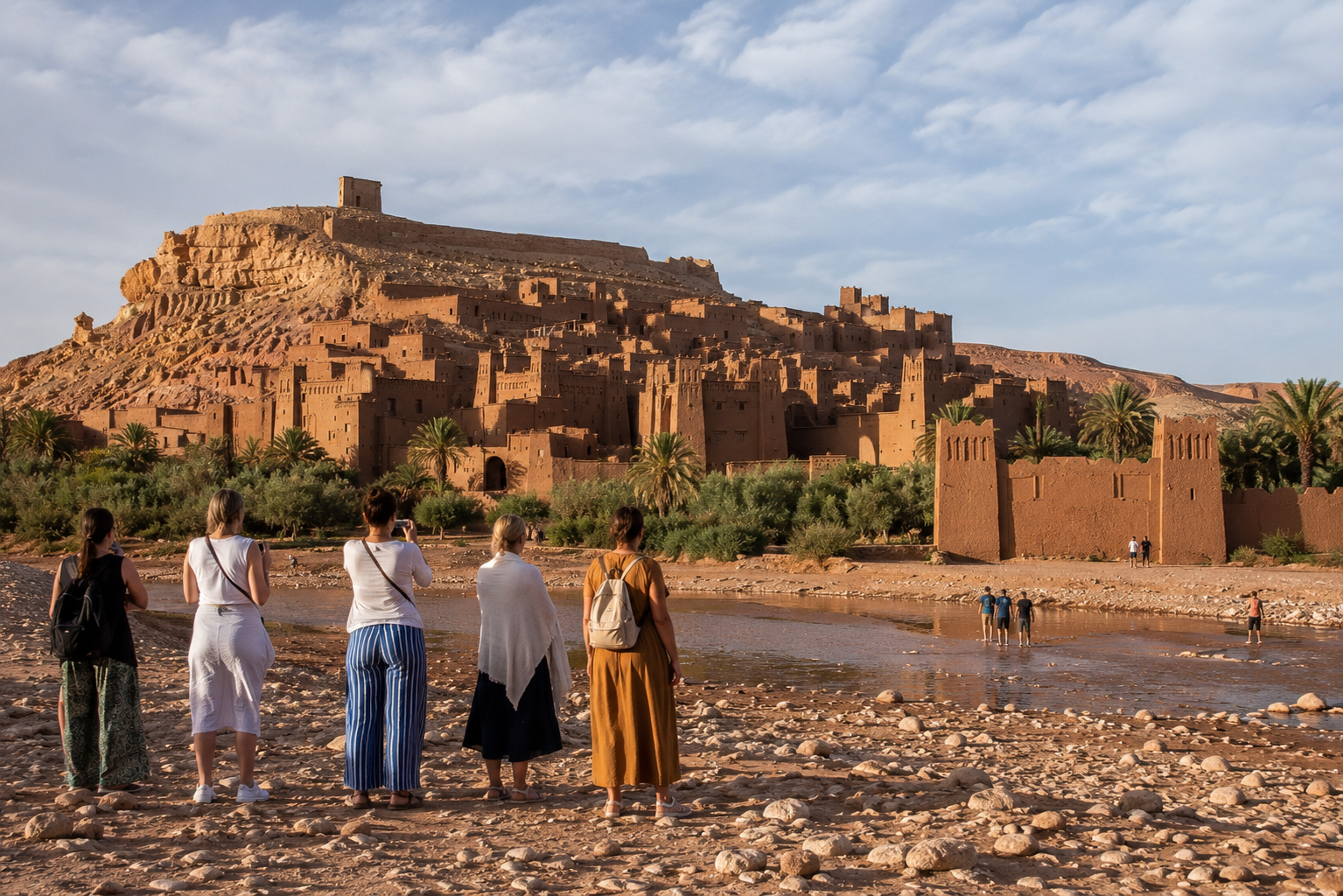
By midday we reach Aït Benhaddou — the UNESCO-listed earth-and-clay kasbah you'll recognise from Gladiator, Game of Thrones, Lawrence of Arabia, The Mummy, and a dozen other films. We cross the riverbed (or take the bridge in winter) and walk up through the village. Lunch is in a riad-restaurant overlooking Aït Benhaddou (your choice of tagine or salad).
The afternoon takes us east through Ouarzazate (sometimes called the Hollywood of Morocco for the film studios). A short stop at the Taourirt Kasbah (sixteenth-century, on the edge of town) before we continue east along the Road of a Thousand Kasbahs.
By late afternoon we arrive at your riad in the Dades Valley. The riad sits in the valley with a terrace that catches the last light on the canyon walls.
You spend the night in a traditional riad in the Dades Valley with an en-suite room. Breakfast at the Marrakech riad, lunch en route, and dinner at the Dades riad are included.
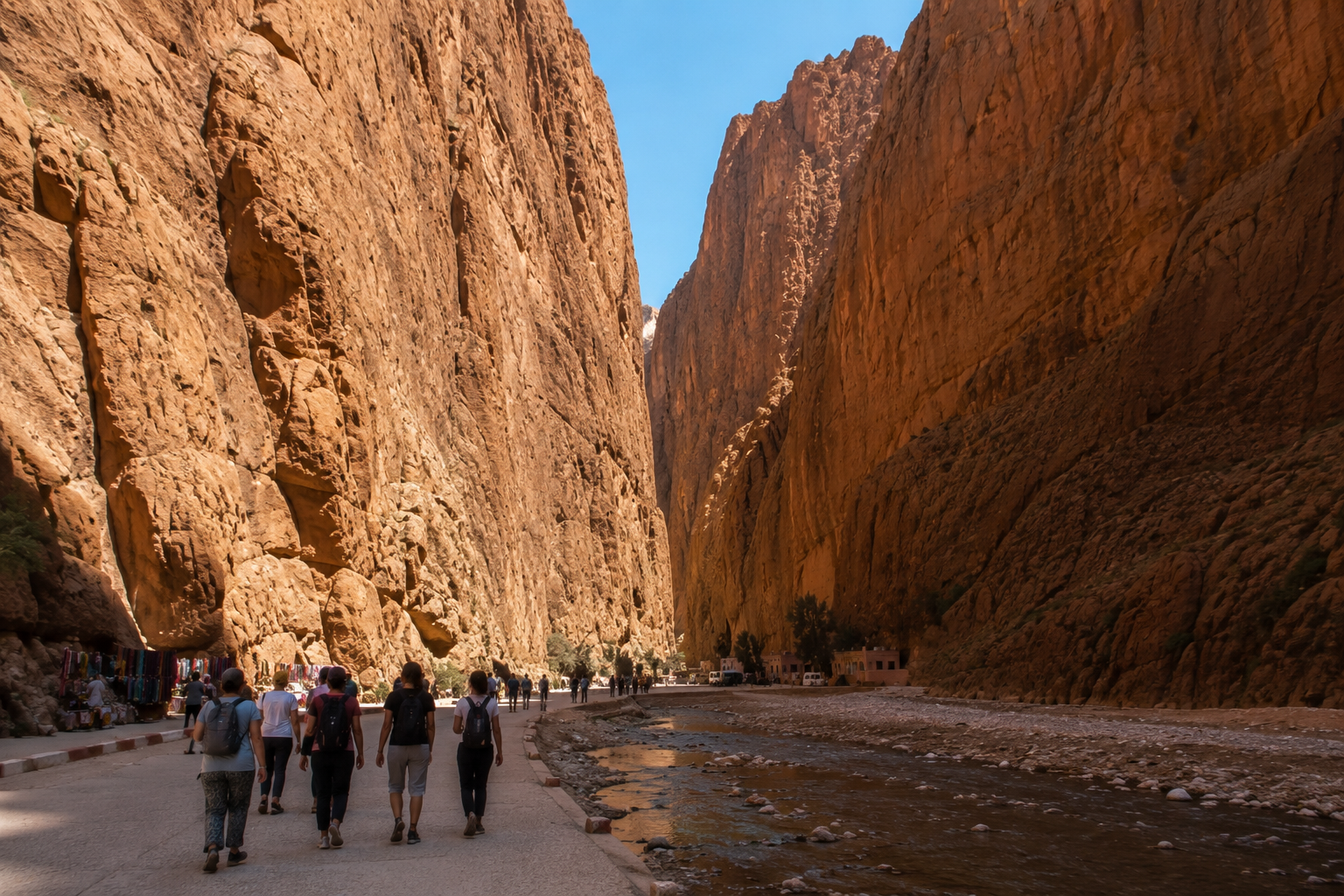
After breakfast we drive east through the Dades Valley and out to the Todgha Gorge — limestone walls rising 300 metres above a stream. We walk the floor of the gorge for thirty to forty minutes; you set the pace. There is a tea stop at a Berber-run café in the gorge if you want one (often run by a woman, your driver-guide will know).
Lunch is in Tinghir or in the gorge area. The afternoon takes us east through Tinjdad, the palm groves of Touroug, and Erfoud (the fossil town).
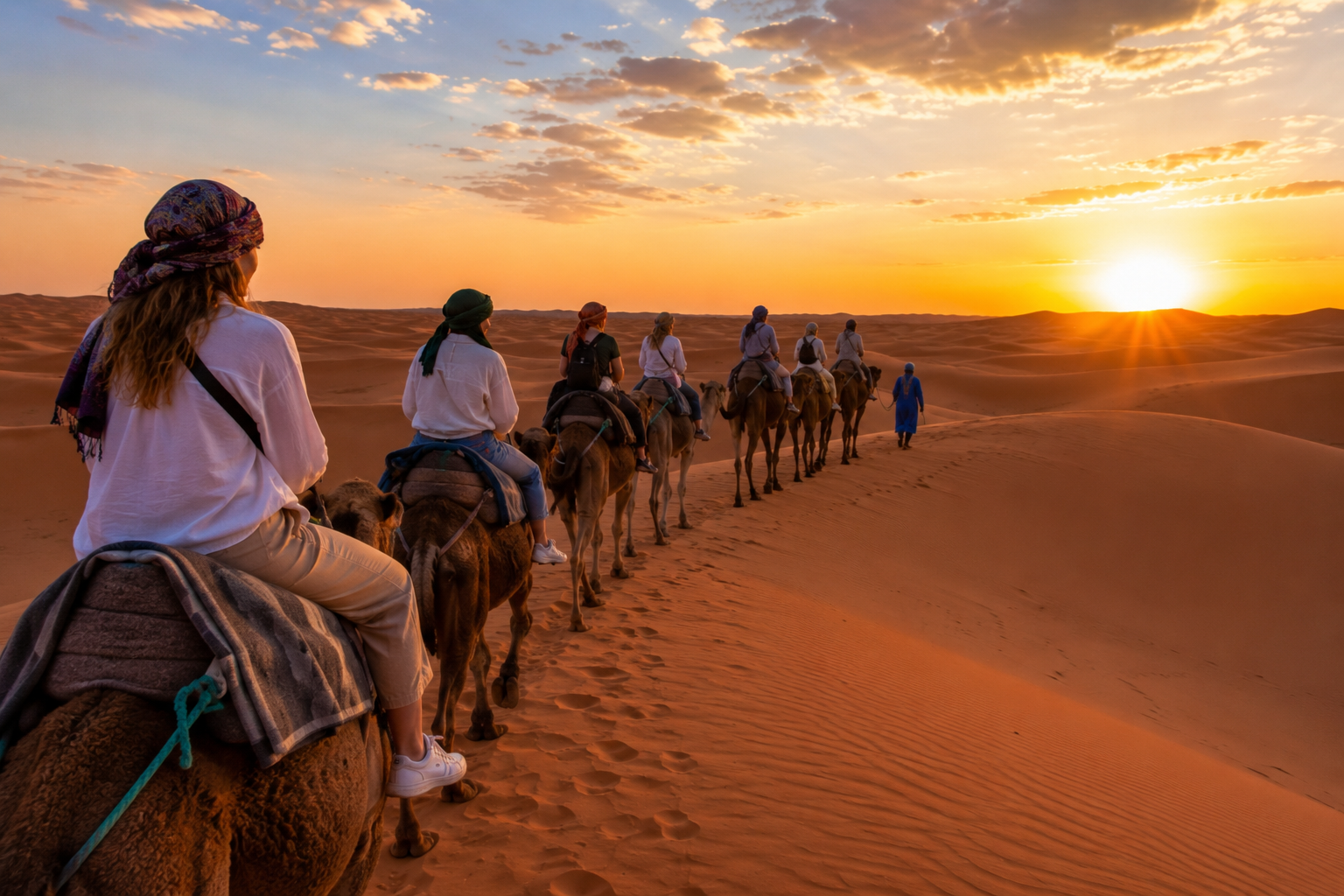
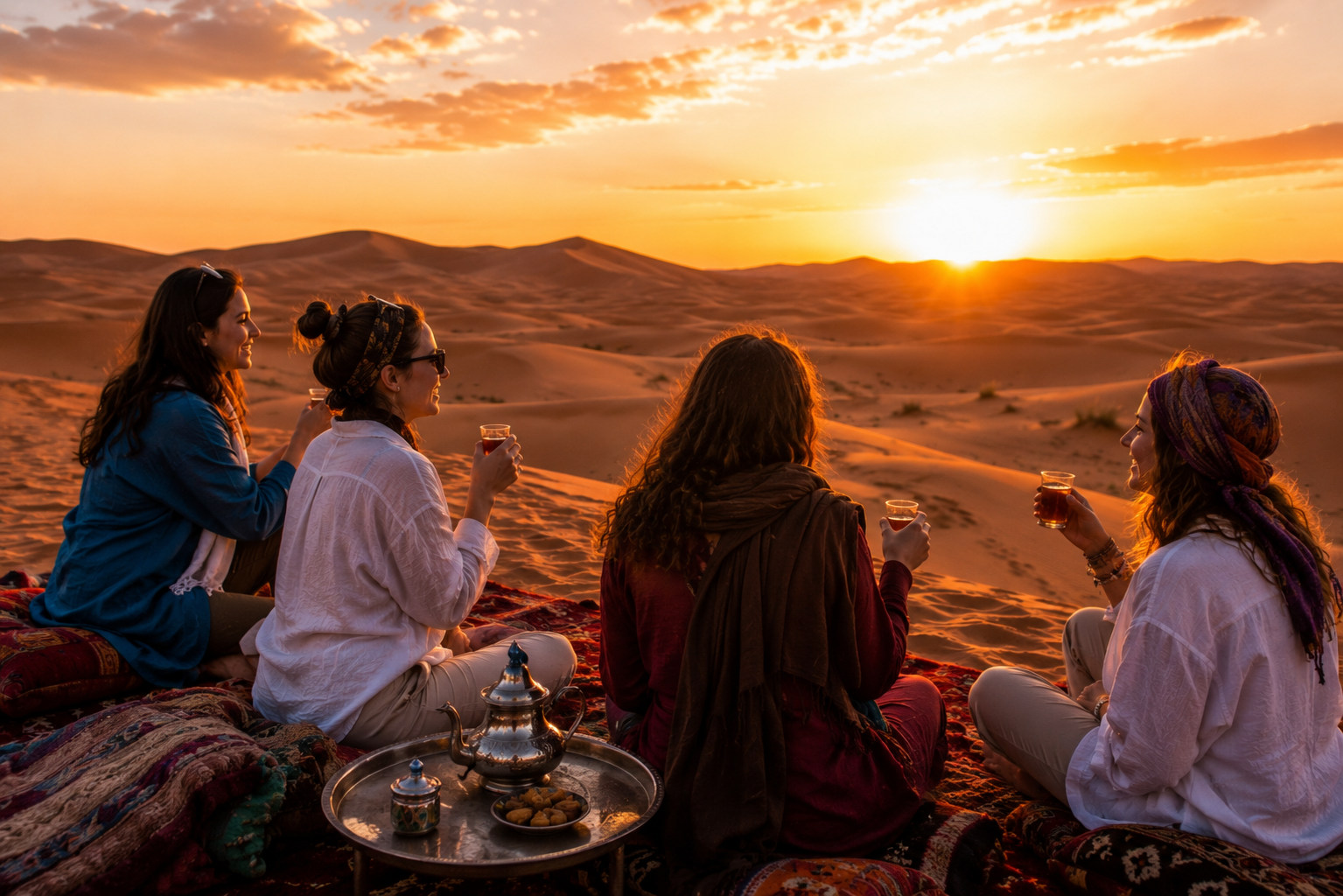
We arrive at the edge of Erg Chebbi in the late afternoon. The dunes rise 150 metres from the desert floor. We switch from the vehicle to the camel for the trek into the dunes — about an hour. Each traveller has her own camel; the camel handler walks alongside. If you'd rather not ride, we drive you to camp by 4×4 — same camp, no negotiation needed.
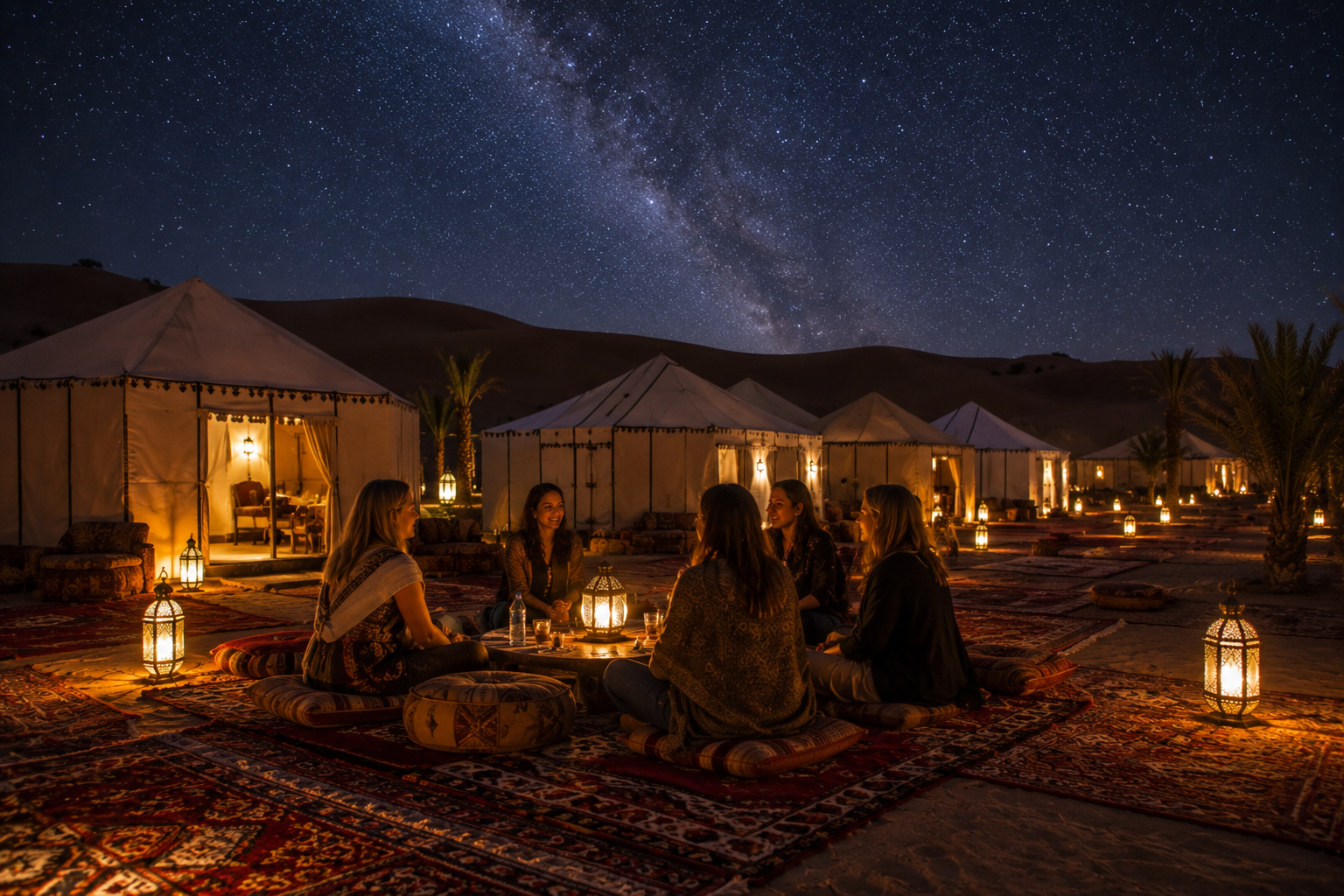
The camp is a permanent setup of private en-suite tents arranged around a communal fire pit. Your tent has a full bathroom with hot shower, real bed with linens, electric lighting, and a chair on the small verandah outside. Dinner is around a long communal table with the other guests at the camp (mixed gender — the camp is not women-only, and we don't pretend it is).
After dinner there is Berber music around the fire — the camel handlers and camp staff sing and play, you can join or just listen. The stars are extraordinary. Some travellers walk fifteen metres into the dunes for the silence; we recommend it.
You spend the night in a private en-suite Berber tent in the Erg Chebbi dunes. Breakfast at the Dades riad, lunch en route, and dinner at the camp are included.
Note: the camp is mixed-gender for staff and other guests. Your tent is private and lockable from inside. Most travellers find the mixed-gender atmosphere of the desert evening (with music and travellers from many countries) one of the highlights of the trip — but if you prefer, we can arrange dinner served separately in your tent.
This is the long day. We tell you that honestly because the geography of a 6-day Sahara trip from Marrakech doesn't fold any other way — there is no shortcut from Merzouga back to Marrakech.
Sunrise over the dunes is the first thing. You can climb a dune for it, or stay in your tent doorway with coffee — both are valid. After breakfast at camp, you camel back to where the vehicle is waiting (or 4×4 if you took that yesterday).
The first stop is Khamlia, a village six kilometres south of Merzouga settled by descendants of sub-Saharan slaves brought to Morocco — the community calls itself Gnawa. Their music is a fusion of West African rhythms and Moroccan instruments, and Khamlia women have storytelling traditions that pass between generations. We arrange morning at the women's house: tea, traditional bread baked in the ground oven, songs, storytelling. About 90 minutes. Lunch is shared with the women of the village (a tagine cooked over wood fire, simple, excellent). About 200 MAD per traveller goes to the women directly; we don't add a margin.
By 1:00 PM we are back in the vehicle for the long return. The road takes us back through Erfoud, Tinghir, Boumalne Dades, the Valley of Roses (Kalaat M'Gouna, which produces most of Morocco's rose water — in season, late April and early May, the air smells of it), Skoura with its kasbah, and back through Aït Benhaddou (a quick photo if you want). Then the climb over the Tizi n'Tichka pass at 2,260 metres and the descent into Marrakech.
We arrive at your Marrakech riad between 8:00 and 9:00 PM. Dinner at the riad — the cook will have something light and ready (this isn't the night for a heavy meal).
You spend the night in your Marrakech riad. Breakfast at the desert camp, lunch with the women of Khamlia, and dinner at the Marrakech riad are included.
Note: the Day 5 drive is genuinely 9 hours including stops. We break every 2 hours. If you cannot do this drive — for medical reasons, with very young children, or by personal preference — ask us about the 7-day version of this trip that splits Day 5 into two driving days with an overnight near Aït Benhaddou.
Today is the Amal Center morning.
Amal is an NGO founded in 2012 by Nora, a Moroccan woman who started by using her own resources to help disadvantaged women — orphans, widows, divorced and single mothers, women who had worked as child maids. By 2024 the organisation had helped over 300 women complete a six-month culinary training program and find employment in hotels, riads, and restaurants across Marrakech.
The cooking class is in the Targa neighbourhood (the centre's main location — there's also a Gueliz centre for the lunch restaurant). We collect you from the riad at 8:30 AM. The class runs from 9:00 AM to roughly 12:30 PM and is taught in English (or French, Arabic, Spanish if you prefer — book the language when we book the date).
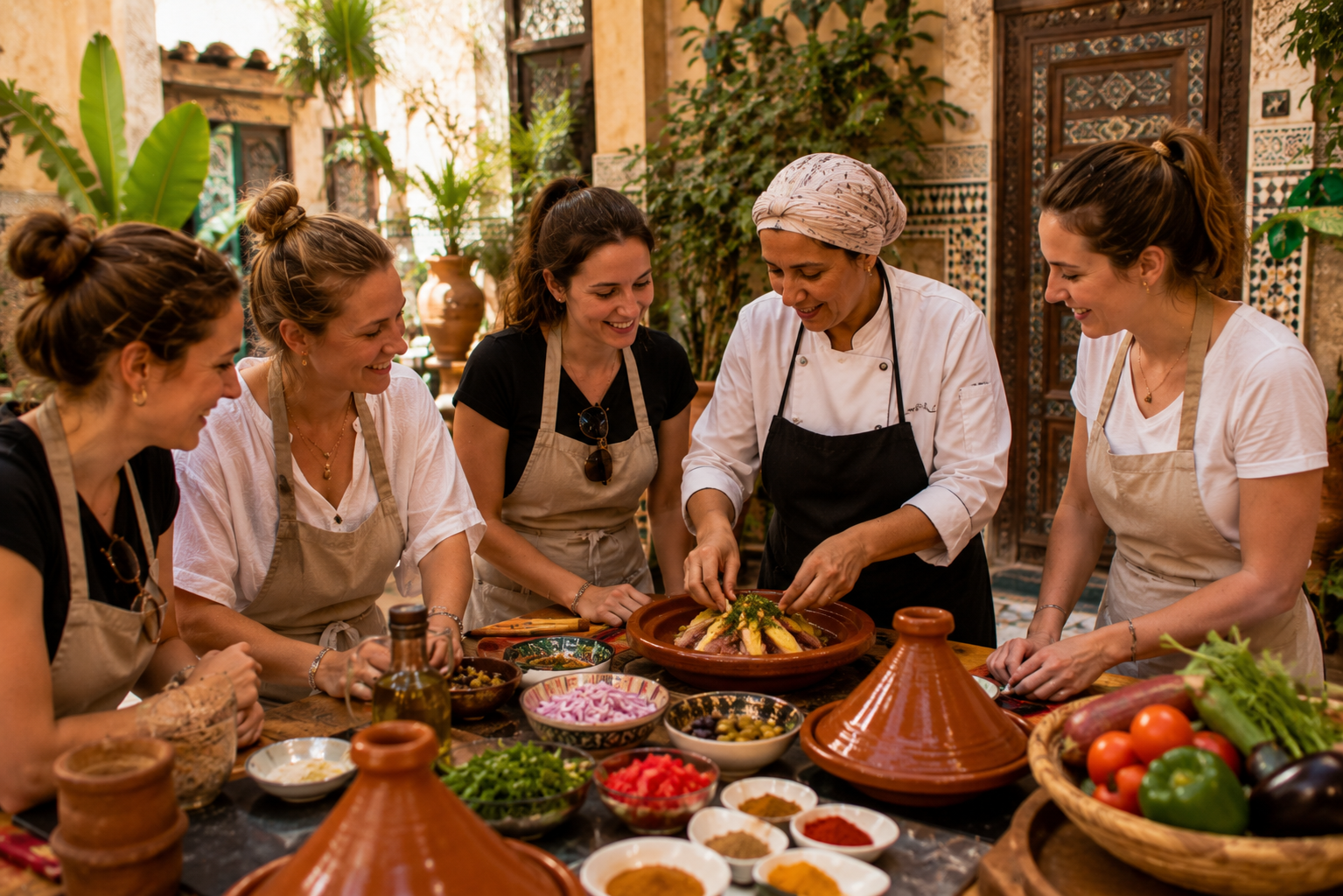
The class is hands-on. You choose a Moroccan dish from a list of eight (chicken tagine with preserved lemon and olives, lamb tagine with prunes and almonds, vegetable couscous, chicken pastilla, several others) and cook it alongside the trainer and the trainees of the centre. While the tagines simmer over charcoal (90 minutes), there is a Moroccan tea ceremony and a conversation about the work Amal has been doing for over a decade. The trainer is one of the centre's chef-instructors, sometimes joined by Nora herself if she is in town.
You eat what you have made at a long shared table — you, the trainer, the trainees who are working their training shift, and any other guests in the class. The food is excellent (Amal's restaurant draws 250+ customers for its Friday couscous service alone).
By 12:45 PM the class is finished. We bring you back to the riad to collect your luggage if you want, or directly to Marrakech-Menara airport for your flight. Most international flights from RAK are early afternoon to evening; we time the airport drop accordingly.
Breakfast at the Marrakech riad and lunch at the Amal Center are included. Dinner is on your flight or after.
If your flight is in the late evening and you want a half-day extension before the airport — coffee in the Majorelle Garden (Yves Saint Laurent's blue garden, entry 150 MAD), a short browsing in the souks, or a final hammam — we can arrange it. Costs depend on what you want; tell us when booking.
Includes & Excludes
What's included
Not included
Frequently Asked
Morocco has one of the lowest crime rates in the world and, compared to the US and Europe, is considered a very safe destination. Moroccan people are known for their hospitality and they will make you feel very welcomed, for more information on the topic contact us and we’ll provide you with some personal single-traveller experiences.
No. You may wear whatever you feel comfortable in, we only have one exception on tours of the Mosque like Hassan II. To enter you would need to dress conservatively as you would in a church (no shorts, tanks tops, etc.).
As in any country you should use direction with your attire if you want to avoid unwanted attention.
US Dollars, Sterling and Euros are readily exchangeable. We recommend you take a mixture of cash and credit cards. Scottish bank notes and Australian dollar travellers cheques and cash are NOT normally accepted in Morocco.
With accurate information on the schedule of your arrival, our guide and our driver await you at the customs exit at the airport, with a sign with your name and first name. It’s always easy, this appointment. In case of concern, you can contact us by phone with our contact information noted in our emails. We are always at your disposal 24 hours a day
Eight things, concretely. (1) Female driver-guide for the entire 6 days. (2) Female cultural guide for the Marrakech medina day. (3) Welcome dinner at a female-managed Marrakech riad. (4) Henna application on Day 1 evening by the Henna Cafe (a women-led NGO). (5) Women-only hammam slot booked at the riad on Day 2 evening. (6) A women's argan oil cooperative visit on Day 3 — a working cooperative, not a tourist demo. (7) Khamlia Gnawa village on Day 5 morning, with lunch and storytelling with the Berber women of the village. (8) Amal Center cooking class on Day 6 — a real Marrakech NGO that has trained over 300 disadvantaged Moroccan women in culinary skills since 2012. The trip also has 2 extra Marrakech days versus the standard trip, which is what allows the medina day with the female guide and the Day 6 morning at Amal. The standard trip is $899 for 4 days; this trip is $1,499 for 6 days with all the women's-focused additions.
We confirm female driver-guide assignment when you book. Morocco's driver-guide industry is male-dominated; Morocco Way actively recruits and trains female drivers, but we don't have unlimited staff. If our female driver is not available on your specific dates, we tell you in advance — usually within 24 hours of your booking enquiry — and you can choose to wait for available dates or proceed with a male driver-guide (at a $150 per person discount, since one of the trip's core differentiators is removed). We don't surprise you on Day 1 with a male driver. Honesty matters here.
This trip is designed for women travelling without male companions. We don't accept mixed-gender bookings. Our reasoning: the experiences are designed around an all-women dynamic — the medina day with the female guide, the women-only hammam slot, the Khamlia visit with the Berber women, the Amal Center cooking class. Adding a male partner changes the dynamic of the women-led experiences. If you and your partner want a private trip with female-focused experiences, we'd rather direct you to our standard 4-day Sahara round trip (WPMMM4) and add custom female-focused additions à la carte (cooperative visits, Henna Cafe, Amal Center cooking class) — send us a WhatsApp for a custom quote on that.
Yes — it was designed primarily for solo female travellers, alongside female friend groups, mother-daughter pairs, and women's groups. The female driver-guide and small private setup make it more comfortable than a group tour for solo women. The solo rate is $2,998 (full single occupancy on the vehicle, accommodation, and guide). If you'd like to share with another solo female traveller on the same dates, we sometimes match — send us a WhatsApp early in the booking process and we'll let you know if anyone else has booked your dates.
The hammam is a Moroccan steam-bath ritual: warm room → hot room → exfoliation by an attendant with a black soap and a kessa (rough mitt) → rinse → cool room → tea. Around two hours total. The hammam at our riad on Day 2 evening is a private indoor hammam booked exclusively for our group (women only — no other guests). Your attendant is a Moroccan woman. Most travellers wear a swimsuit or bikini bottoms; some go bare. Both are normal — Moroccan women in the local public hammams typically go in just bottoms. Bring a swimsuit if you'd prefer one. The riad provides towels and a kessa. If you'd rather skip the hammam entirely (some travellers find the exfoliation too vigorous, or just don't enjoy steam rooms), no problem — we don't charge you for it ($40 per person, paid at the riad if you do it).
Pack what you normally use; pharmacies are everywhere in Marrakech, Erfoud, and along the route. The female driver-guide will not ask, but knows how to point you to a pharmacy or a quiet rest stop without making it awkward. Period products (tampons, pads) are available at any Moroccan pharmacy — Tampax, Always, and Carefree are all sold. The desert camp toilet has running water; the riads all have private bathrooms. The camel ride can be skipped (no judgement, no negotiation). The hammam can be skipped. Activities are à la carte — if you don't want to do something, you don't.
Moroccan dress code is more relaxed than many people expect, especially for visitors. In the medina you'll see Moroccan women in everything from full hijab to jeans-and-T-shirt to sleeveless dresses. As a visitor, what you'll be most comfortable wearing: shoulders covered (T-shirt or above), legs covered to the knee or below, comfortable closed-toe walking shoes for the medina, layers (Marrakech can be hot in the day and cool in the evening, the desert is cold at night). For the hammam: swimsuit or bottoms only (you'll be doing the steam-and-scrub thing). For the camel ride: long pants you don't mind getting dusty, sturdy shoes. For the desert evening: warm layers (it can drop below 5°C in winter nights). Nothing requires a headscarf except mosques (you won't be entering any working mosques on this trip). Most travellers wear less than they expected to — it's hot, the sun is strong, and Marrakech has been hosting visitors for decades.
Yes, broadly — Morocco is generally safe for solo female travellers with normal precautions. The challenge most solo female travellers report is verbal harassment in tourist-heavy medinas (catcalling, persistent vendor approaches), not violence. On this trip, you're with a female driver-guide and a female cultural guide for the days that involve walking the medina, which dramatically reduces the harassment baseline. You're also private (not in a public bus or shared tour). The places we go — the riads, Aït Benhaddou, the Sahara camp, Khamlia, Amal — are all places we know our travellers have been comfortable in before. We're not pretending Morocco doesn't have catcalling; we're saying we've designed the trip to minimise it. If something happens that makes you uncomfortable, your female driver-guide handles it — that's part of her job.
No. The argan cooperative on Day 3 is a 30-minute visit; you can buy a small bottle of oil if you want (no markup — the price is what the cooperative charges, around 200 MAD for a 250ml culinary argan bottle). Most travellers buy something small to support the cooperative; about 30% buy nothing. Both are completely fine. The Khamlia village visit has no shopping; you'll be invited to leave a tip for the women if you'd like (we suggest 50-100 MAD per person). The Amal Center cooking class has no shopping component; the class fee (which we pay) covers the centre's costs. There's no commission incentive on this trip. Your driver-guide is salaried, not commissioned. We don't take you to leather souks or carpet shops where the seller pays the guide a kickback for bringing you (this is unfortunately common with male driver-guides in Morocco; we've explicitly excluded it).
Khamlia is a village six kilometres south of Merzouga, settled by descendants of sub-Saharan Africans brought to Morocco — historically through trans-Saharan slave trade, more recently through migration. The community calls itself Gnawa. Their music is a fusion of West African rhythms and Moroccan instruments (the gembri lute, the krakebs metal castanets), and Khamlia women have storytelling traditions that pass between generations. We visit because (a) it's a culturally significant community we want our travellers to engage with respectfully, (b) the village's economy benefits directly from cultural visits like ours, (c) the women in particular have a different position in this community than in mainland Berber/Arab Moroccan villages, with stronger oral traditions and more visible presence in cultural performance. The morning is tea, traditional bread baked in the ground oven, songs, and storytelling. Lunch is shared. We send 200 MAD per traveller directly to the women's collective; we don't add a commission.
Amal is a Marrakech NGO founded in 2012 by Nora, a Moroccan woman who started using her personal resources to help disadvantaged women — orphans, widows, divorced and single mothers, women who had worked as child maids, women with little or no education. By 2024 the organisation had trained over 300 women in a six-month culinary program (cooking, service, hygiene, foreign languages, health) and helped them find employment. The class on Day 6 is hands-on — you cook a Moroccan dish (chicken tagine, lamb tagine, vegetable couscous, chicken pastilla, several others) alongside one of the centre's chef-trainers and the current trainees. While your dish simmers, there's a Moroccan tea ceremony and a conversation about the centre's work. You eat what you've made at a shared table. About 3 hours total, ending around 12:30 PM. The fee (which we pay as part of the trip cost) supports the centre's training program.
Yes, honestly: Day 5 is approximately 9 hours including stops, with about 580 km of driving from Merzouga back to Marrakech. The geography of a 6-day Sahara round trip from Marrakech doesn't fold any other way — you have to drive back on Day 5 to get to Marrakech for the Amal Center morning on Day 6. We break the day every 2 hours for tea, fuel, or a short walk. If you cannot do this drive — for medical reasons, with very young children, or by personal preference — we offer a 7-day version that splits Day 5 into two driving days (Merzouga → Khamlia → Aït Benhaddou overnight, then Aït Benhaddou → Marrakech on Day 6, with the Amal Center on Day 7 morning). The 7-day version is $1,799 base. Send us a WhatsApp if you'd like to switch to the 7-day version.
The camel ride is not compulsory — we transfer you to camp by 4×4 instead if you prefer (same camp, same dinner, same view). Just tell us when booking. The desert camp itself is not women-only; we're honest about that. The camp is a permanent setup with private en-suite tents (your tent is private and lockable from inside). The camel handlers and most kitchen staff are male; the manager and some of the activity staff may be female. The other guests at camp are mixed gender (other private tour groups, often couples and families). Most of our women's-tour travellers find the mixed-gender camp evening (with travellers from many countries, music around the fire) one of the highlights of the trip — but if you'd rather have dinner served separately in your tent for privacy, we can arrange it with the camp manager.
March to May and September to November are ideal — mild days, warm desert nights, predictable weather. March-May has the rose harvest in the Valley of Roses (you'll smell it on Day 5 if you travel late April / early May). June to August is very hot in the desert (35-45°C) and in Marrakech (often 40°C+); we run the trip but recommend an air-conditioned tent upgrade. December to February has cold desert nights (sometimes below freezing) and occasional snow on the Tizi n'Tichka pass; the trip is still beautiful but pack warm layers. Ramadan affects meal timing slightly (lunch options thinner during daylight; dinners at the riad shift to after sunset). Tell us when booking and we'll plan around the dates.
Yes. Common extensions: 2 extra nights in Essaouira after Day 6 (we drop you Marrakech → Essaouira on Day 6 instead of airport, then Essaouira → Marrakech airport on Day 8), adding around $400 per person; an extra day in Marrakech on Day 7 for the Majorelle Garden, the souks, more medina time (around $200 per person extra, including lunch); adding the Henna Cafe full cooking workshop on Day 1 evening instead of just the henna application (around $50 per person extra). Send us a WhatsApp for a custom quote.
Through our website with PayPal, or via WhatsApp (+212 628 848 511) for a custom quote. We confirm female driver assignment within 24 hours of your booking enquiry. A 25% deposit secures your dates; the balance is paid in cash to your driver-guide on Day 1, or in advance via PayPal. Free cancellation up to 14 days before departure. For solo female travellers wanting to be matched with another solo for share rates, contact us early — matching depends on whether other solos book your dates.