Overview
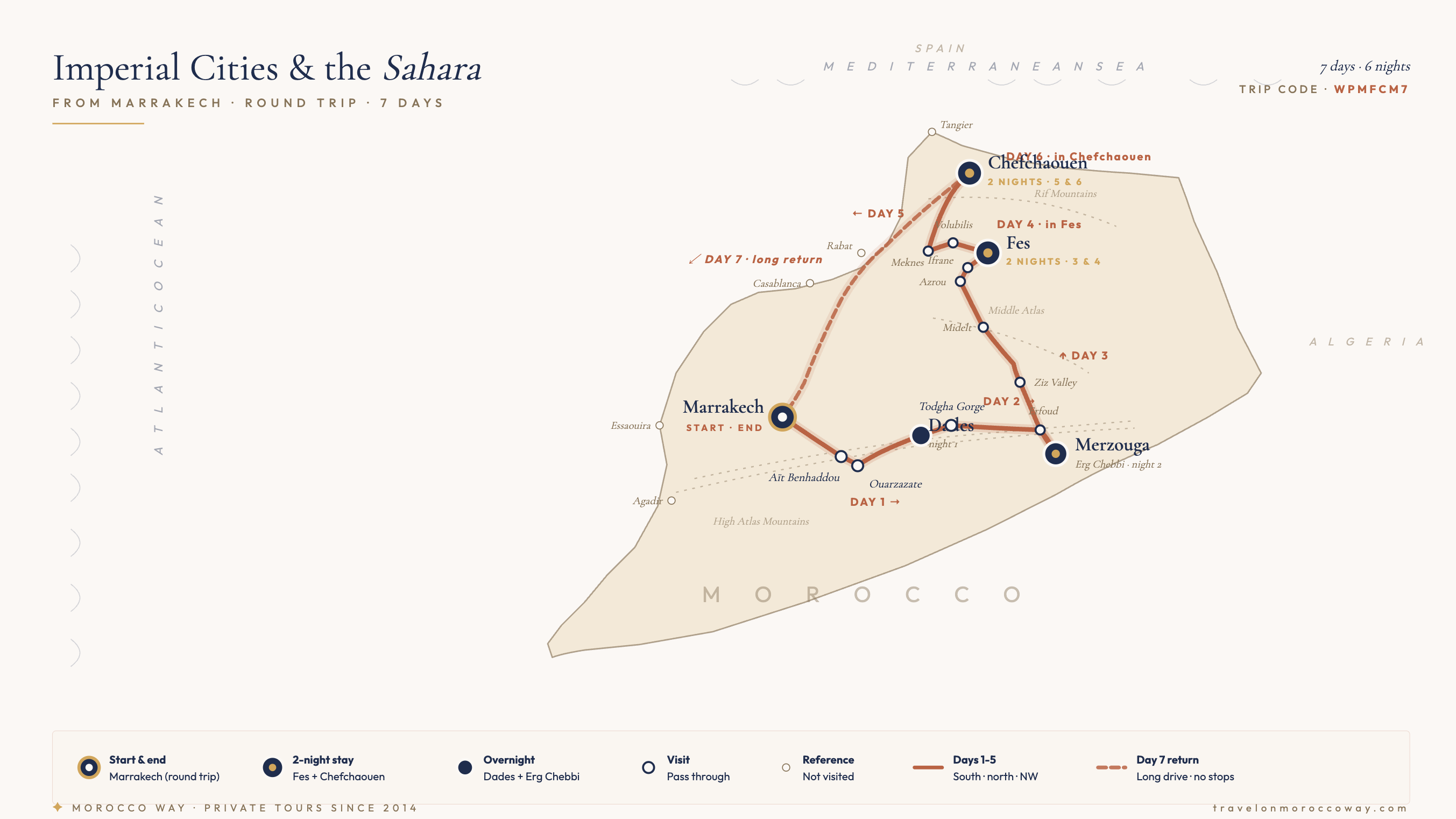 Seven days. Six nights. The High Atlas, the Sahara, the imperial cities of Fes and Meknes, the Roman ruins at Volubilis, and the blue medina of Chefchaouen — without ever doubling back on a road.
This is the flagship. If you have one week in Morocco and you want all of it, this is the trip. The 3-day round trip gets you to the desert. This trip gets you to the desert and to everything else.
Days 1 and 2 are the route Morocco Way has been refining since 2014: over the High Atlas, the UNESCO kasbah of Aït Benhaddou, the Road of a Thousand Kasbahs, Dades Valley, Todgha Gorge, and a private Berber camp on the Erg Chebbi dunes for sunset and stargazing.
Day 3 is the long climb north through the Ziz Valley, Midelt, the cedar forest near Azrou (wild Barbary macaques), and Ifrane to Fes. Two nights in Fes means Day 4 is yours — and ours. We include a licensed local guide who walks you through the oldest car-free medina on earth: the Chouara tannery, Al Quaraouiyine (the world's oldest continuously operating university, founded 859 AD), the Bou Inania madrasa, and a few places only locals find.
Day 5 takes the imperial corridor: Volubilis (Roman ruins, third-century mosaics, UNESCO), Meknes (Bab Mansour, the colossal granary at Hri es-Souani), then the climb into the Rif Mountains to Chefchaouen — the Blue City — for two nights.
Day 6 is yours in Chefchaouen. The blue medina is best photographed before 10:00 AM. The Spanish Mosque hike at sunset is the second view. Between them, you wander, drink mint tea, and recover from five days on the road.
Day 7 is the long return: Chefchaouen to Marrakech in a single day, around 600 kilometres on the inland highway. We're honest that this is the longest driving day of the trip. We can also drop you in Casablanca for a flight if that's where you fly out.
Everything is private. Your driver-guide is yours alone. Your Toyota Land Cruiser is yours alone. Your tent in the desert is yours alone. We adjust each day to suit your pace.
Best for: travellers who have one week, want every Morocco icon, and don't want to compromise on the depth of any of them. Honeymooners, families with older children, friend groups, photographers, and first-time Morocco travellers who want to see the country properly.
Not the right fit if: you cannot sit in a vehicle for six hours on Day 7. The geography doesn't fold, and we won't pretend it does. If that drive concerns you, ask us about flying Casablanca-Marrakech on Day 7 instead — we can arrange the flight as an upgrade and use the saved time for a half-day in Casablanca.
Day by Day
We collect you from your hotel or riad in Marrakech at 8:00 AM. The first hour leaves the city and starts climbing — within ninety minutes you are on the Tizi n'Tichka pass at 2,260 metres, the highest road crossing in North Africa.
The first major stop is Aït Benhaddou, the UNESCO-listed earth-and-clay kasbah you will recognise from Gladiator, Game of Thrones, Lawrence of Arabia, and a long list of other films. We cross the riverbed (or take the bridge in winter) and walk up through the village. If you want a local guide for the kasbah itself, we arrange one for €3 per person. Lunch is in a family-run spot we trust.
The afternoon takes the Road of a Thousand Kasbahs through Ouarzazate, past the Skoura palmeraie and the Valley of Roses at Kalaat M'Gouna. We arrive in Boumalne Dades in the late afternoon. Your riad sits in the valley with a terrace that catches the last light on the canyon walls.
You spend the night in a traditional riad in the Dades Valley with an en-suite room. Dinner is included.
After breakfast we head east to Tinghir and the Todgha Gorge — limestone walls rising 300 metres above a stream. We walk the floor of the gorge for thirty to forty minutes; you set the pace.
Lunch is in Tinghir or en route. The afternoon drive crosses the high desert: Tinjdad, Erfoud (the fossil town), and then the dunes appear on the horizon.
We arrive at the edge of Erg Chebbi in the late afternoon and switch from the vehicle to the camel. The trek into the dunes takes about an hour. If you would rather not ride a camel, we drive you to camp by 4×4 — same camp, no negotiation needed. The sunset from the top of a dune is what it is. Bring your phone.
The camp is a permanent setup. Your private tent has an en-suite bathroom with a hot shower, a real bed with linens, and lighting. Dinner is around a communal table. After dinner there is Berber music around a fire, or you can walk fifteen metres into the dunes for the silence and the sky. The stars are extraordinary.
You spend the night in a private Berber tent with en-suite bathroom in the Erg Chebbi dunes. Breakfast, lunch, and dinner are included.
Sunrise over the dunes is the second reason people come. After breakfast at camp, you camel back to where the vehicle is waiting (or 4×4 if you took that yesterday).
The drive north begins at Erfoud and quickly turns into one of Morocco's most photographed stretches of road: the Ziz Valley. A ribbon of date palm oasis cuts through red sandstone cliffs for nearly fifty kilometres. We stop at the panoramic viewpoint where the contrast is sharpest.
We continue north through Errachidia and over the Tizi n'Talghamt pass, then into Midelt for lunch. Midelt is the apple capital of Morocco, sitting in the saddle between the Middle and High Atlas.
The afternoon takes you into the cedar forest near Azrou — North Africa's largest cedar forest, with trees over 400 years old. Wild Barbary macaques live here. We stop on a quiet road, not the bus-tour pull-in, and you will likely see them. Please do not feed them; we will explain why when we arrive. From the cedar forest we pass through Ifrane, the so-called Switzerland of Morocco.
We arrive in Fes between 5:00 and 7:00 PM. We drop you at your Fes riad in the medina. The walk in from the gate is short.
You spend the night (and the next) in a traditional riad inside the Fes medina. Breakfast at the camp and lunch in Midelt are included. Dinner is at your own choice tonight — we recommend a couple of riad rooftop options in your area.
Today is on foot, with a licensed Fes medina guide who has grown up inside it. The medina is the largest car-free urban area on earth and one of the most intricate. You will not navigate it without help. You will get help.
The morning starts with the Bab Boujloud (the Blue Gate) and weaves through to the Bou Inania madrasa — fourteenth-century, still working, with carved cedar and zellij tile that takes time to read. From there to Al Quaraouiyine, founded in 859 AD by Fatima al-Fihri and the world's oldest continuously operating university and library. Non-Muslims cannot enter the prayer hall but we can see the courtyards.
By late morning you are at the Chouara tannery — the medieval leather-dyeing pits that have looked the way they look for nine hundred years. We hand you a sprig of mint to hold to your nose; you will need it. The view from the leather shop terraces above is the photograph everyone has seen.
Lunch is in a riad restaurant your guide knows. After lunch, the smaller workshops: the metalworkers, the woodturners, the henna market in the Place Seffarine. The Royal Palace exterior in the late afternoon — the brass doors are a working postcard. We end at the rooftop of one of the riads or at a café terrace overlooking the medina, in time for sunset over Fes.
You spend a second night in your Fes riad. Breakfast is at the riad; lunch is at your guide's choice. Dinner is at your own choice — we recommend a couple of options nearby.
Today is the imperial corridor. We leave Fes after breakfast and drive northwest into the green plains.
The first stop is Volubilis — Morocco's best-preserved Roman ruins, UNESCO-listed, third century AD at peak. The mosaics are still in the floor, weathered but legible: Orpheus playing the lyre, the labours of Hercules, the chariot of Bacchus. The site is open and uncrowded; you walk where Roman officials walked. We allow about ninety minutes.
Lunch is in Meknes, the imperial city built by Moulay Ismail in the seventeenth century. We walk the Bab Mansour gateway (the most ornate gate in Morocco, finished in 1732), the Hri es-Souani — Moulay Ismail's colossal underground granary built to feed twelve thousand horses — and the Place el-Hedim. Meknes is the imperial city travellers tend to skip. We don't think you should. Two hours is enough.
The afternoon climbs north into the Rif Mountains. Chefchaouen sits at 600 metres in a fold of the Rif, painted blue. We arrive in the late afternoon. The walk into the medina is short; the riad door is in a wall, marked only by its small painted sign.
You spend the night (and the next) in a traditional riad inside the Chefchaouen medina. Breakfast in Fes, lunch in Meknes (your choice — we'll suggest), dinner in Chefchaouen at the riad or at one of the rooftop spots we recommend.
Today is yours. After five days on the road, the recovery is part of the trip.
The blue medina is best photographed before 10:00 AM, when the light is soft and the tour groups have not yet arrived. We will tell you which alleys are worth it (Ras el Maa, the corner near the Outa el Hammam square, the alley with the geraniums above the kasbah). You can wander.
The Outa el Hammam square is the centre. A coffee or mint tea on the terrace there, looking up at the kasbah, is the morning. Inside the kasbah is a small museum with paintings and weavings; entry is 60 dirhams.
The afternoon, if you have the legs for it, is the Spanish Mosque — a fifteen-minute climb on the outskirts of town. The view of the blue medina laid out below is the photograph people came to Chefchaouen for. Sunset is the time. Light shoes, water bottle.
Dinner is on a rooftop. We will have pre-recommended three places.
You spend a second night in your Chefchaouen riad. Breakfast is at the riad; lunch and dinner are at your own choice and pace.
This is the long day. We tell you that honestly because there is no shortcut between Chefchaouen and Marrakech — the geography doesn't fold and the highway is the most direct route.
We leave Chefchaouen at 7:30 AM (a little earlier in winter for daylight). The route runs west through Ouezzane and meets the inland highway near Meknes (which we don't re-enter — you've already seen it). From there it's the A1 / A3 motorway south past Khemisset, then Rabat, then Casablanca, then the southern motorway across the Tadla plain to Marrakech.
We break every two hours. Lunch is at a motorway service station — usable but unremarkable. We don't pretend it's a highlight.
We arrive in Marrakech in the late afternoon, around 5:00 to 6:00 PM. We drop you at your hotel or riad. If you flew in via Marrakech, you know the way. If you have a flight out tonight, we drop you direct to the airport.
A flight upgrade option: if a six-hour drive is too much for the last day, we arrange a Casablanca-to-Marrakech flight at extra cost — we'd drop you in Casablanca around 12:30 PM, you'd fly Marrakech at around 4:00 PM, arriving by 5:00 PM. Saves about three hours of driving for around $90 per person. Tell us when booking.
Breakfast in Chefchaouen is included. Lunch (motorway) is at your own expense. Dinner in Marrakech is at your own choice.
Includes & Excludes
What's included
Not included
Frequently Asked
Morocco has one of the lowest crime rates in the world and, compared to the US and Europe, is considered a very safe destination. Moroccan people are known for their hospitality and they will make you feel very welcomed, for more information on the topic contact us and we’ll provide you with some personal single-traveller experiences.
No. You may wear whatever you feel comfortable in, we only have one exception on tours of the Mosque like Hassan II. To enter you would need to dress conservatively as you would in a church (no shorts, tanks tops, etc.).
As in any country you should use direction with your attire if you want to avoid unwanted attention.
US Dollars, Sterling and Euros are readily exchangeable. We recommend you take a mixture of cash and credit cards. Scottish bank notes and Australian dollar travellers cheques and cash are NOT normally accepted in Morocco.
With accurate information on the schedule of your arrival, our guide and our driver await you at the customs exit at the airport, with a sign with your name and first name. It’s always easy, this appointment. In case of concern, you can contact us by phone with our contact information noted in our emails. We are always at your disposal 24 hours a day
Because it covers every Morocco icon — High Atlas, Sahara, imperial Fes, Roman Volubilis, blue Chefchaouen — without doubling back on a single road. Most 7-day itineraries either skip the desert (and you regret it) or skip Chefchaouen (and you regret it). This one fits both, plus two nights in Fes which is genuinely needed to read that medina, plus a full rest day in Chefchaouen because by Day 6 you have earned it. The geography is honest about a long Day 7, and we offer a flight upgrade if that drive is too much.
Day 1 about 7 hours (350 km), Day 2 about 6 hours plus camel trek (350 km), Day 3 about 8 hours (470 km), Day 4 walking only inside Fes, Day 5 about 5 hours plus stops (280 km), Day 6 walking only inside Chefchaouen, Day 7 about 9 hours (600 km). Days 4 and 6 are deliberately out of the vehicle. Day 7 is the longest driving day; we offer a Casablanca-Marrakech flight upgrade for travellers who'd rather skip it.
You can walk it. You will get lost. The Fes medina has roughly 9,000 streets and alleys with very few signs. Beyond the navigation issue, the workshops and historic buildings (Bou Inania, Al Quaraouiyine, the tannery) read very differently with someone who knows the history and the trades. Our included local guide grew up inside the medina, speaks fluent English, and knows which workshops let you watch craft and which don't. Their lunch recommendation alone is usually worth the day. After Day 4 with the guide, you'll navigate Fes confidently for the evening on your own.
Because this is a fully private tour. The price covers a private vehicle, a private driver-guide, a private tent in the desert camp, a private riad room in three different cities, and a private licensed guide for the Fes day. These costs are the same whether one person or two travel. The $1,499 per-person rate assumes two travellers sharing those costs. Solo travellers get the same private experience but pay full single-occupancy. If you are a solo traveller looking to share, send us a WhatsApp — we sometimes match solo travellers with others on similar dates.
Standard tier: well-reviewed riads inside both medinas with en-suite rooms and rooftop terraces (typically 4-star equivalent — names depend on availability for your dates and we'll confirm). Comfort tier (an upgrade we'll quote): 5-star riads with full hammam services. Luxury tier (further upgrade): heritage palaces — places like Riad Fes or La Maison Bleue in Fes, Lina Ryad & Spa in Chefchaouen. We name the actual property in your booking confirmation, not generic "4-star riad."
No. If you would rather not ride, we transfer you to camp by 4×4 — same camp, same dinner, same view. Mention it when booking.
Almost always, yes. The cedar forest near Azrou has a resident wild population of around 5,000 Barbary macaques. We take you to a quieter section a few minutes off the standard tourist pull-in. We ask you not to feed them — it conditions them to dependent behaviour and shortens their lives.
Before 10:00 AM. The blue alleys photograph best in soft morning light, before the day-trip groups arrive from Fes and Tangier. Your second photography window is at sunset from the Spanish Mosque hill — fifteen-minute uphill walk from the medina, the panorama of the blue town below at golden hour is what most people came for. Your driver-guide will tell you the exact alley to start with.
Children from around eight years old usually love this trip — the camel ride, the desert camp, the monkeys in the cedar forest, the colour of Chefchaouen, the maze of Fes. Three days of long driving in a week is a lot for very young children; under six, we can suggest a 5-day version that drops Volubilis and Meknes. We fit child seats. The Fes medina is the most demanding day on foot — we adjust the pace for younger kids.
March to May and September to November are ideal — mild days everywhere, warm desert nights. June to August is very hot in the desert and in Fes; we run the tour but recommend an air-conditioned tent upgrade and we shift outdoor walks to early morning. December to February has cold nights in the desert and in Chefchaouen (which sits at 600 metres) and snow in the cedar forest; some travellers love that, but pack warm layers.
Casablanca has the Hassan II Mosque (one of the largest in the world) and not much else worth your day. If you have an extra day, we recommend adding it to Fes (a third night) or Marrakech (a pre-tour or post-tour night) instead. If you must see Casablanca, the Day 7 flight upgrade we mentioned passes through Casablanca and we can arrange a short Hassan II Mosque visit before the flight at additional cost.
Yes — that is the point of private. Common customisations: adding a day in Marrakech at the start, adding a cooking class in Fes, swapping standard riads for luxury heritage properties, adding a hot air balloon over the High Atlas on Day 7 morning before the drive, or extending Day 6 in Chefchaouen with a Rif Mountains hike. Tell us when you enquire.
Free cancellation up to 21 days before departure (we hold riad rooms in Fes and Chefchaouen ahead, so the window is longer than our shorter trips). Cancellations 14 to 20 days out: 25% retained. 7 to 13 days: 50% retained. Less than 7 days: 75% retained. We are flexible if there is a genuine reason such as illness or a family emergency — talk to us.